

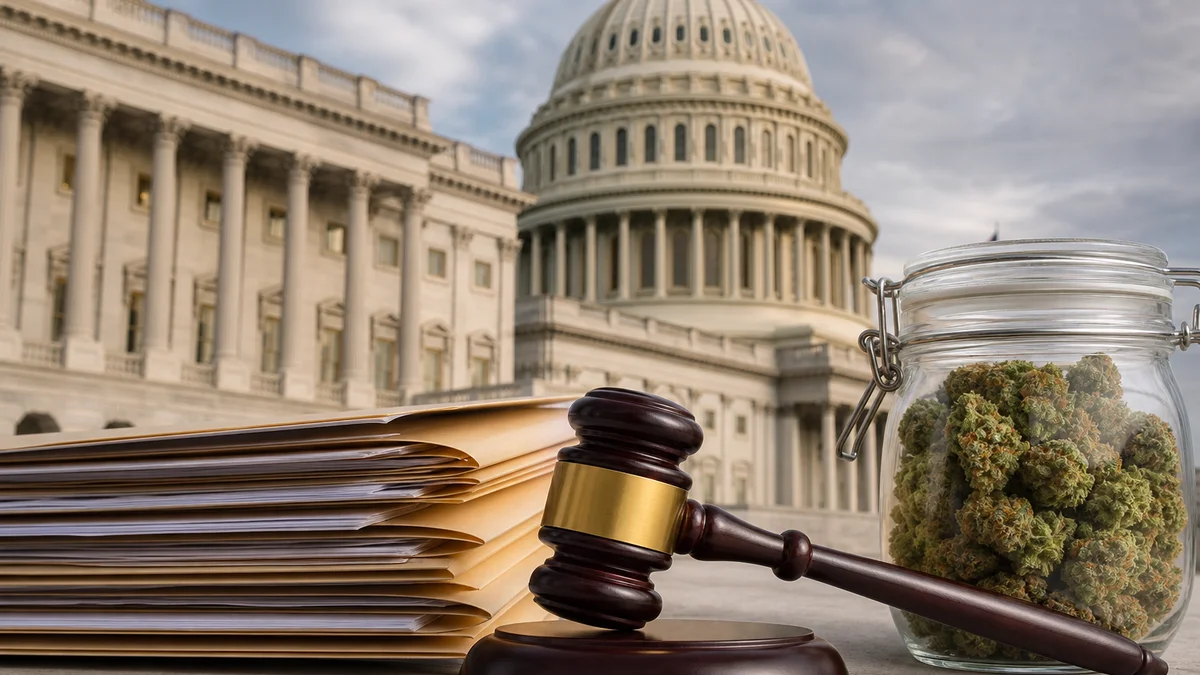
President Donald Trump has commuted the federal marijuana sentences of Jerry Haymon IV and Kevin Harden, marking his first cannabis-related clemency actions while the administration advances a rescheduling process that could move marijuana to Schedule III.
The commutations arrive as the Drug Enforcement Administration reviews marijuana's placement under the Controlled Substances Act. But the limited scope of Trump's clemency—just two individuals—has reignited debate over what happens to the thousands of people serving federal sentences for marijuana offenses while the government simultaneously acknowledges the drug's reduced scheduling status.
Haymon and Harden were both convicted under federal marijuana laws that treated cannabis as a Schedule I substance with no accepted medical use. Details about their specific charges and sentence lengths were not immediately available from the White House.
The Rescheduling Timeline
The Department of Health and Human Services recommended in August 2023 that marijuana be moved to Schedule III, a category reserved for drugs with accepted medical uses and lower abuse potential than Schedule I or II substances. The DEA accepted that recommendation and opened a public comment period that closed in July 2024.
Rescheduling would not legalize marijuana federally. It would remain a controlled substance, though businesses could finally deduct normal operating expenses on their taxes and researchers would face fewer barriers to studying the plant. The change would also acknowledge what 38 states have already determined: that cannabis has legitimate medical applications.
But rescheduling does nothing for people currently incarcerated under the old scheduling regime.
The Clemency Gap
Policy analysts have long pointed out the disconnect between marijuana policy reform and criminal justice relief. More than 2,700 people are serving federal sentences for marijuana-related offenses, according to recent Bureau of Prisons data. State prisons hold thousands more.
"When you change the underlying law but leave people in prison under the old law, you're essentially saying their punishment was unjust—but you're keeping them there anyway," said Rachel Gillette, executive director of the Colorado cannabis trade group Marijuana Industry Group, in a 2023 interview about federal rescheduling.
The Biden administration granted pardons in October 2022 to all Americans convicted of simple federal marijuana possession. But that action covered fewer than 10,000 people, none of whom were in federal prison at the time. The pardon did not extend to distribution, cultivation, or possession with intent to distribute—the charges that account for nearly all federal cannabis incarceration.
Trump's two commutations represent a fraction of potential relief. The question facing advocates is whether the administration will tie rescheduling to a broader clemency initiative or treat the two issues separately.
What's Next
The DEA has not announced a timeline for finalizing the Schedule III determination. The agency must review public comments and conduct additional analysis before issuing a final rule. Legal challenges are expected regardless of the outcome.
Meanwhile, clemency advocates are pushing for Trump to expand relief beyond Haymon and Harden. The Last Prisoner Project, which works to free people incarcerated for cannabis, maintains a list of federal prisoners serving sentences for marijuana offenses. The organization has submitted multiple clemency petitions to the White House.
Trump granted 237 pardons and commutations during his first term, including several for drug offenses. His approach to cannabis clemency in this term has yet to take clear shape.
The Haymon and Harden commutations offer a test case for how the administration will handle the tension between rescheduling marijuana and addressing past enforcement of stricter laws. Two cases down, thousands to go.
This article is based on original reporting by hightimes.com.