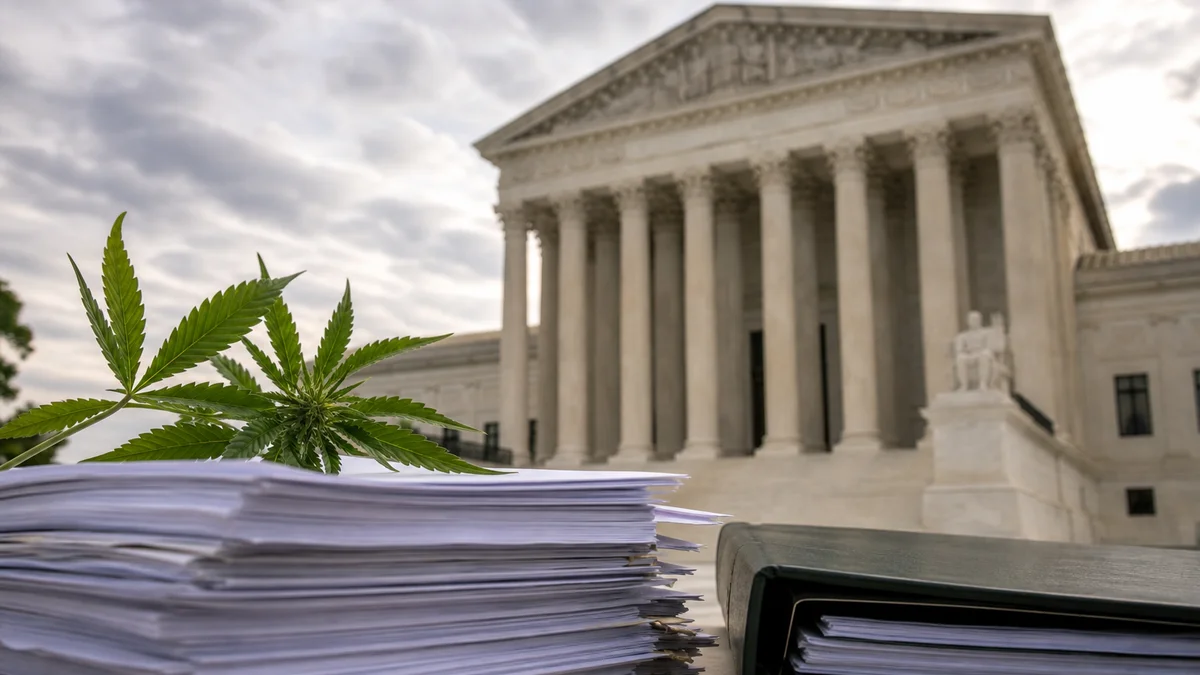
A cannabis entrepreneur denied business licenses in Washington and California has asked the U.S. Supreme Court to decide whether states can legally restrict marijuana business ownership to their own residents.
The petition, filed last week, seeks to resolve conflicting decisions among federal appeals courts about residency requirements in state cannabis licensing systems. The operator—who applied for licenses in Washington State and Sacramento—argues that such restrictions violate the dormant Commerce Clause of the U.S. Constitution.
The case arrives as more than two dozen states have legalized adult-use marijuana, many with residency requirements designed to keep local ownership and prevent out-of-state capital from dominating emerging markets. But federal courts have split on whether these protections are constitutional.
The Constitutional Question
The dormant Commerce Clause prevents states from discriminating against interstate commerce, even when Congress hasn't explicitly regulated an area. The petitioner contends that marijuana business licensing should fall under this protection, despite cannabis remaining federally illegal.
Two federal circuit courts have reached opposite conclusions on the issue. The Ninth Circuit, which covers Western states including Washington and California, has upheld residency requirements in cannabis licensing. The First Circuit, covering New England, struck down Maine's residency requirement in 2022, finding it unconstitutional.
This circuit split gives the Supreme Court a compelling reason to take up the case. When different regions apply different constitutional standards, the high court often steps in to establish uniform law.
Industry Stakes
Residency requirements have become a flashpoint in cannabis policy debates. Advocates argue they prevent large multi-state operators from monopolizing new markets and ensure local communities benefit from legalization. Critics say they limit capital access and create inefficient markets.
"These requirements were designed to give local entrepreneurs a fighting chance," said one policy analyst familiar with Washington's licensing system. "But they also make it harder for businesses to scale and attract investment."
At least 15 states with legal marijuana programs maintain some form of residency requirement for license applicants. Requirements vary—some demand years of state residency, others require majority ownership by residents. States including Illinois, New Jersey, and Michigan have residency provisions in their adult-use programs.
The financial implications are substantial. Multi-state operators have long sought to expand into markets where residency rules block them. Meanwhile, local business owners fear losing competitive advantages if courts strike down these protections.
What Happens Next
The Supreme Court receives thousands of petitions annually and accepts fewer than 100 cases. The justices will likely decide whether to hear this case in the coming months.
If the Court takes the case, oral arguments would probably occur in late 2025 or early 2026, with a decision by June 2026. If the Court declines, the circuit split would persist, meaning residency requirements remain valid in some regions but not others.
The timing coincides with ongoing federal rescheduling discussions. The Drug Enforcement Administration is reviewing a proposal to move marijuana from Schedule I to Schedule III, which could affect how courts view interstate commerce arguments.
Legal experts note the Court's conservative majority has shown skepticism toward state laws that discriminate based on residency in other contexts. But the federal illegality of marijuana adds a unique wrinkle that could influence the justices' thinking.
For now, cannabis businesses and state regulators are watching closely. A Supreme Court decision either way would reshape licensing systems across the country and potentially unlock—or close off—billions in cross-border investment.
This article is based on original reporting by www.marijuanamoment.net.