Size matters more than most people think
Rolling paper size directly controls how much herb fits in a joint, how long it burns, and whether the paper-to-herb ratio works in your favor. Most people use whatever size came with their first pack without ever questioning it. If that size happens to be wrong for how you smoke, you end up frustrated without knowing why.
Here's every standard size, what the actual dimensions are, and when each one makes sense.
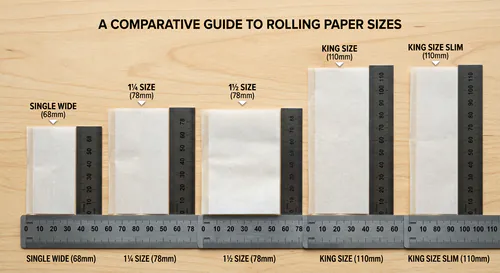
Single wide
Dimensions: approximately 68 x 34 mm. Herb capacity: 0.25 to 0.5g.
Single wide is the smallest standard size. The joint you produce is narrow and short -- closer in diameter to a cigarette than to anything you'd roll for a group. Burn time is fast: a well-packed single wide is finished in 5 to 10 minutes.
Single wides are genuinely useful for solo sessions where you want a quick smoke without committing to more herb. They're also easier to roll than larger sizes because there's less paper to manage. The short length means any technique flaws are less obvious. For someone learning to roll, starting on single wides is actually a solid approach.
The limitation is pure capacity. If you're sharing with even one other person, a single wide will be finished before it makes it around twice. They're also not great for mixing herbs or adding concentrates because there's just not enough space.
1 1/4 size
Dimensions: approximately 78 x 45 mm. Herb capacity: 0.5 to 0.75g.
This is the global default. When a brand makes one size, it's usually 1 1/4. When a tutorial doesn't specify size, it's assuming 1 1/4. The name comes from being 1.25 times the width of a single wide, though in practice that measurement isn't precise across brands.
The 1 1/4 produces a joint that works well for one to two people. It's the size most pre-rolled cones use. It's wide enough to pack evenly without excessive technique and long enough to give a satisfying smoke without being so big that it becomes a project to finish.
If you're unsure what size to use, use 1 1/4. Most of the technique advice you'll find online is calibrated for this size. Most filter tip cards are sized with this in mind. It's the standard for a reason.
1 1/2 size
Dimensions: approximately 78 x 60 mm. Herb capacity: 0.75 to 1g.
The 1 1/2 is wider than 1 1/4 but the same length. The result is a fatter joint rather than a longer one. This size isn't as common as 1 1/4 or king size -- it occupies an awkward middle ground that many smokers skip over entirely.
Where it does make sense: if you want a joint that holds more without going all the way to king size length, or if you prefer a wider shape that's easier to pack than trying to over-stuff a 1 1/4. Some rollers find the extra width actually easier to work with because there's more room to distribute herb before tucking.
King size
Dimensions: approximately 100 to 110 x 55 mm. Herb capacity: 1 to 1.5g.
King size papers produce joints that are both longer and wider than 1 1/4. A well-packed king size joint will take 15 to 25 minutes to smoke and is appropriate for groups of three or four people.
The common mistake with king size papers is using them when you don't need to. A king size joint rolled with less than 0.8g ends up looking like a flimsy tube with too much paper. The extra paper doesn't disappear -- it burns and you taste it. King size only makes sense when you're filling it properly.
Rolling technique matters more at king size than at smaller sizes. Any inconsistency in distribution (too dense at one end, too loose at another) shows up as uneven burning more dramatically on a long joint. If you're still developing your rolling skills, stay at 1 1/4 until your technique is consistent.
King size slim
Dimensions: approximately 105 to 110 x 42 mm. Herb capacity: 0.75 to 1.25g.
King size slim is longer than king size but narrower. The joint that results has a more elegant, cigarette-like shape. Because the diameter is smaller, it tends to burn more evenly and the herb-to-paper ratio stays good even if you don't pack it completely full.
This is my personal preferred size for most situations. The longer burn time of a king slim versus a 1 1/4 is noticeable, and the narrower diameter means better combustion control. RAW King Size Slim is probably the most-used paper in this category. OCB Slim is another solid choice.
King slim is also the format where the difference between rice paper and wood pulp is most apparent. On a longer joint, a slow-burning rice or hemp paper maintains even combustion better than a faster-burning wood pulp paper.
98 Special
Dimensions: approximately 98 x 60 mm. Herb capacity: 1 to 1.5g.
The 98 Special is popular in North America but less common elsewhere. It falls between 1 1/4 and king size in length but is wider, producing a stubby, fat joint shape. RAW 98 Special and other brands use this format primarily for cones, where the wide opening makes filling easier.
If you roll by hand rather than filling cones, the 98 Special isn't the most intuitive size to work with. But if you buy pre-rolled cones to fill yourself, this is the size you'll encounter most in North American dispensaries.
Double wide
Dimensions: approximately 78 x 88 mm. Herb capacity: 1.5g+.
Double wide papers are for fat joints. Very fat joints. They're twice the width of a single wide and produce something closer to a small blunt in diameter. Practically speaking, they're hard to roll well, burn quickly relative to the herb inside, and produce more smoke per puff than most people want on a daily basis.
They exist. They're fine for novelty purposes or for large groups. They're not a regular-use product.
Slim vs regular width
Within each length category, you'll often see both "slim" and "regular" (or "wide") versions. The slim designation means the paper is narrower front-to-back, producing a thinner joint. Regular width gives you more rolling room but a fatter result.
Slim papers require slightly more rolling precision because the narrower width leaves less margin for error in the tuck. Regular width is more forgiving. If you're still learning, stick with regular width in your size category before moving to slim.
Size comparison quick reference
| Size | Length | Width | Capacity | Good for |
|---|---|---|---|---|
| Single wide | 68 mm | 34 mm | 0.25 to 0.5g | Solo, quick smoke |
| 1 1/4 | 78 mm | 45 mm | 0.5 to 0.75g | Default, 1 to 2 people |
| 1 1/2 | 78 mm | 60 mm | 0.75 to 1g | Fatter joint, same length as 1 1/4 |
| King size | 100 to 110 mm | 55 mm | 1 to 1.5g | Groups of 3 to 4 |
| King size slim | 105 to 110 mm | 42 mm | 0.75 to 1.25g | Long burn, elegant shape |
| 98 Special | 98 mm | 60 mm | 1 to 1.5g | Cones, North American standard |
| Double wide | 78 mm | 88 mm | 1.5g+ | Novelty, large groups |
Which size should you actually use
If you smoke alone most of the time: 1 1/4 or single wide. There's no reason to burn a king size joint by yourself. You'll either rush through it or put it out and relight it, neither of which is ideal.
If you smoke with one other person regularly: 1 1/4 is still fine. King size slim is a good upgrade if you want a longer session.
If you're usually in a group of three or more: king size slim or king size regular. King slim is the better choice if anyone in the group rolls with any skill. King size regular is better if someone is rolling for a group quickly and needs the extra width to pack efficiently.
If technique is still a work in progress: 1 1/4 with a regular (not slim) width. The forgiving dimensions make the learning curve easier. Once you're consistently rolling tight joints, experiment with king slim for the burn quality.
For more on paper selection beyond just size -- materials, brands, burn rate -- the rolling papers buyers guide covers all of it in detail. And if you want to practice your technique with a specific paper, the guide to rolling with RAW papers walks through the process step by step.
For dispensaries and businesses looking at branded paper options, all of these sizes are available in custom formats. The rolling papers section has more on what's orderable in custom quantities.
Once you know your size, the branded rolling papers guide covers putting your own logo on booklets and cones.